
From Teak Decks to Composites: The Evolution of Marine Construction Materials
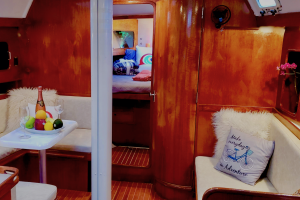 When you come down to the marina, you’ll see big difference between our sailboat, Therapy, and our power boat, Irie Vibes. Down below on Therapy, almost everything is made of teak; on Irie Vibes, nothing is made of teak. Even on deck, only Therapy has teak on it, namely the tow rail and hand rails. Varnishing the teak is other story!
For centuries, teak has been the gold standard in marine construction, gracing the decks of everything from royal naval vessels to luxury yachts. This remarkable wood’s journey from Southeast Asian forests to boat decks tells a story of craftsmanship, durability, and ultimately, conservation awareness. Today, as the marine industry increasingly embraces composite materials, we’re witnessing a fascinating transition that balances tradition with sustainability.
The Teak Legacy in Marine Construction
Teak’s reputation in boat building isn’t just about aesthetics—though its warm, honey-colored grain and smooth texture certainly contribute to its appeal. This tropical hardwood possesses a unique combination of properties that made it indispensable for marine applications. Its natural oils provide exceptional water resistance, while its tight grain structure offers remarkable stability in the harsh marine environment where wood constantly expands and contracts with moisture and temperature changes.
The wood’s natural silica content gives it excellent non-slip properties on deck surfaces. This characteristic, combined with its resistance to rot, insects, and marine borers, made teak the preferred choice for everything from deck planking to trim work, handrails, and interior joinery.
Traditional teak deck construction involved laying planks in a caulked seam pattern, with black polyurethane or traditional oakum and pitch filling the gaps between boards. This created the classic “yacht deck” appearance that remains synonymous with luxury and quality in the boating world. The material’s workability allowed craftsmen to create complex curves and joints, essential for the organic shapes of boat hulls and superstructures.
Origins and the Geography of Teak
Genuine teak (Tectona grandis) originates from the monsoon forests of Southeast Asia, primarily Myanmar (formerly Burma), with additional sources in Thailand, Laos, and India; some trees grow for over 150 years before harvest. The quality of teak varies significantly based on growing conditions. Slow-growing trees from drier regions produce denser wood with tighter grain patterns and higher oil content—the characteristics most prized in marine applications. Thai teak, grown in the country’s northern provinces, has traditionally been considered among the finest.
Beyond these traditional sources, teak plantations have been established in other tropical regions including Indonesia, Costa Rica, Panama, and various African countries. However, plantation-grown teak, while more sustainable, often lacks the density and oil content of old-growth forest timber, leading to ongoing debates about quality versus environmental responsibility.
The Conservation Challenge
But, the marine industry’s love affair with teak has come at a significant environmental cost. Decades of intensive harvesting severely depleted natural teak forests, leading to international conservation efforts and trade restrictions. The Convention on International Trade in Endangered Species (CITES) now regulates teak trade from Myanmar, requiring documentation proving legal harvest and export. Many countries have implemented their own restrictions, and some regions have seen near-complete deforestation of native teak stands.
Importantly, this environmental pressure has sparked several conservation initiatives. The Forest Stewardship Council (FSC) now certifies sustainably harvested teak, providing boat builders and owners with environmentally responsible options. Plantation forestry has expanded, with some operations using fast-growing techniques that can produce harvestable teak in 25-40 years, though this wood typically has different characteristics than old-growth timber.
Reclaimed teak has become another important source, with companies specializing in recovering timber from demolished buildings, decommissioned ships, and other sources. This recycled material often possesses the desirable characteristics of old-growth teak while avoiding additional environmental impact.
The Rise of Composite Alternatives
As teak becomes more expensive and environmentally controversial, the marine industry has embraced synthetic alternatives that mimic teak’s appearance and performance while offering additional benefits. Modern composite decking materials represent a significant technological advancement in marine construction and improve in utility yearly.
Synthetic teak alternatives typically combine PVC or polyurethane bases with various additives to achieve the desired properties. These materials are engineered to replicate teak’s appearance, including grain patterns and color variations, while providing superior performance in many areas. They require no finishing, are completely waterproof, and offer consistent non-slip properties regardless of weather conditions.
Foam-backed composite decking provides additional insulation and cushioning underfoot, while maintaining the structural integrity necessary for marine applications. Some premium synthetics even incorporate cork or other natural materials to enhance comfort and authenticity.
Advantages of Modern Composite Materials
The shift toward composites isn’t just about conservation—these materials offer practical advantages that appeal to boat builders and owners alike. Maintenance requirements are dramatically reduced since composites don’t require regular oiling, sanding, or refinishing. They resist staining from spills and don’t harbor bacteria or mold in the same way that natural wood can.
Weight savings represent another significant advantage. Modern composite materials are often 30-50% lighter than equivalent teak installations, improving boat performance and fuel efficiency. For racing sailboats, this weight reduction can provide measurable performance gains.
Consistency is another key benefit. While natural teak varies in density, grain pattern, and oil content, composites provide uniform properties across an entire installation. This predictability helps boat builders maintain quality control and ensures that performance characteristics remain constant throughout the vessel.
Cost considerations also favor composites in many applications. While premium synthetic materials can initially cost as much as quality teak, the elimination of ongoing maintenance expenses often makes composites more economical over a boat’s lifetime. Installation is frequently faster and requires fewer specialized skills than traditional teak work.
Performance Comparisons and Applications
In head-to-head comparisons, modern composites excel in several areas while traditional teak maintains advantages in others. Teak’s natural beauty and the craftsmanship associated with its installation continue to appeal to owners seeking classic aesthetics. The material’s proven track record—some teak decks have performed admirably for decades—provides confidence that’s harder to establish with newer synthetic materials.
However, composites demonstrate superior performance in extreme temperature conditions. While teak can become uncomfortably hot in tropical sun or slippery when wet, engineered materials maintain more consistent surface temperatures and traction properties. This makes them particularly attractive for boats operating in challenging climates.
Different applications favor different materials. For traditional sailing yachts where authenticity matters, carefully sourced teak may still be preferred despite the cost and maintenance requirements. Modern powerboats, fishing vessels, and performance sailboats increasingly specify composites for their practical advantages.
The repair and replacement considerations also differ significantly. Damaged teak requires skilled craftsmen and matching materials that may be difficult to source. Composite materials can often be repaired with standard tools and techniques, and replacement sections are typically available from manufacturers.
Future Trends and Innovations
The marine construction industry continues to innovate in sustainable materials and manufacturing processes. Bio-based composites incorporating natural fibers like hemp, flax, or bamboo offer potential alternatives that combine environmental responsibility with performance. These materials could provide some of the aesthetic appeal of natural wood while delivering the consistency and durability of synthetics.
Advanced manufacturing techniques are producing increasingly sophisticated composite materials. Multi-layer constructions can incorporate different properties in specific zones—soft surfaces for comfort, hard cores for durability, and specialized bottom layers for adhesion or insulation.
3D printing and computer-controlled manufacturing are enabling custom composite installations that would be prohibitively expensive with traditional materials. Boat builders can now create complex curved surfaces and integrated features that seamlessly blend form and function.
Smart materials represent another frontier, with composites that can change properties in response to environmental conditions. Self-heating surfaces for cold climates, materials that become more slip-resistant when wet, or surfaces that indicate maintenance needs are all under development.
Balancing Tradition with Sustainability
The evolution from teak to composites in marine construction reflects broader changes in how we balance tradition, performance, and environmental responsibility. While purists may always prefer the look and feel of genuine teak, the practical and environmental advantages of modern alternatives are compelling.
The key lies in making informed choices based on specific applications and priorities. Restoration projects may justify the use of reclaimed or certified sustainable teak to maintain historical authenticity. New construction increasingly favors composites for their practical advantages and environmental benefits.
Education plays a crucial role in this transition. Boat owners and builders need to understand the true costs—financial, environmental, and practical—of their material choices. The marine industry’s increasing embrace of sustainability certifications and environmental standards suggests that this awareness is growing.
As composite technology continues to advance and teak becomes increasingly scarce and expensive, the shift toward synthetic alternatives seems inevitable. However, the craftsmanship traditions and aesthetic standards established by centuries of teak use continue to influence how we design and build boats today.
The story of teak in marine construction—from its origins in Southeast Asian forests to its modern synthetic successors—illustrates how industries can adapt to environmental challenges while maintaining the performance and beauty that define their products. As we sail into the future, the lessons learned from working with this remarkable natural material continue to inform how we create better, more sustainable boats for generations to come.